Driving in NYC: What They Don't Teach You for the Permit Test in 2026
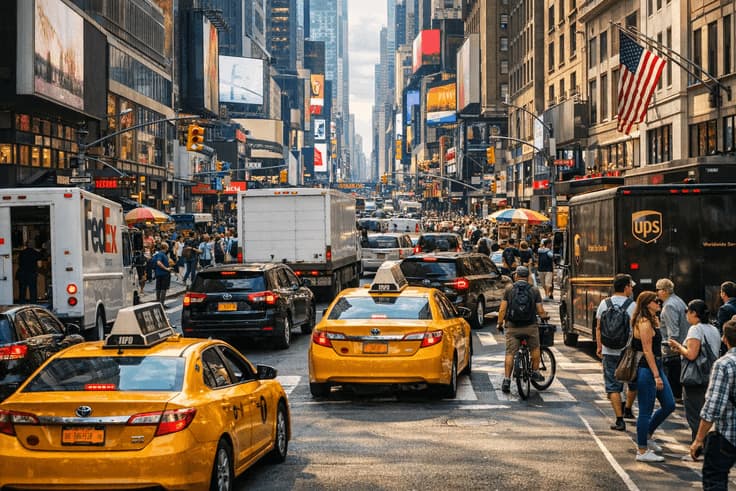
Look, there's a gap between what the permit exam covers and what actually happens when you're behind the wheel in this city. The test gives you rules, signs, neat little scenarios where everyone behaves. The street doesn't work that way. Real driving in NYC means delivery trucks parked in live lanes, pedestrians who launch off curbs without looking, and taxis that brake like they're being chased. All at once, sometimes.
So yeah, people ask: is driving in NYC hard? Honestly, at first it is. But it's not impossible. It's learnable if you understand what the DMV wants from you on paper and what the city demands from you in motion. Those are two different things, and nobody really tells you that upfront.
Deep breath.
Why Driving in NYC Is So Different
Traffic density changes everything. In Rochester or Buffalo, you can usually set up a lane change with plenty of room. In Manhattan or the Bronx, you get a half-car gap and someone leaning on the horn behind you.
It's loud. It's fast. Conditions shift block by block. A green light doesn't mean the intersection is clear - it might be packed with cars that couldn't get through the last cycle. A clear right lane becomes a bus stop in two hundred feet. A double-parked van turns two lanes into one without warning.
You have to read the whole block ahead of you, not just the bumper in front.
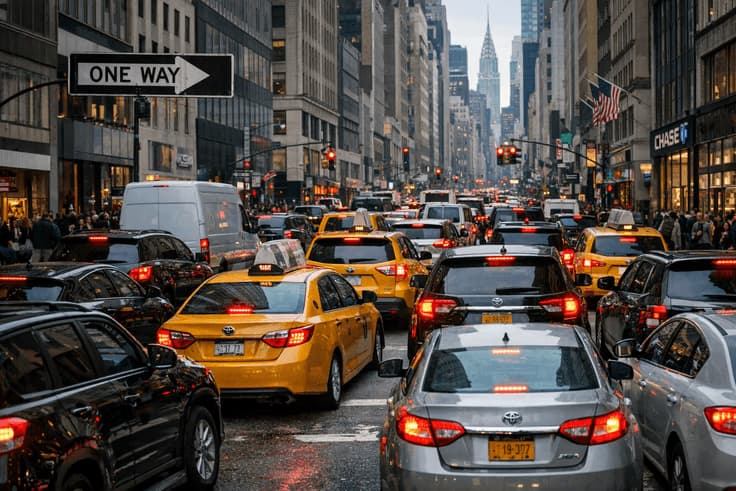
NYC is also loaded with one-way streets and weird intersections. Miss your turn in Midtown, and you don't just loop around. You might get funneled onto an avenue you didn't want, then into a tunnel approach you can't bail out of.
That happens.
Common Challenges New Drivers Face
Most new drivers hit the same walls, and it's not always about skill. It's attention management. You're juggling a cyclist on your right, a pedestrian drifting off the curb, a cab braking hard, and a driver behind you who apparently needed to be somewhere five minutes ago.
Quick decisions matter.
The stress points that come up over and over:
- Double parking forcing sudden lane merges
- Pedestrians entering crosswalks early, late, and sometimes mid-block
- "Polite" drivers waving you through when it's not actually your right-of-way
This one trips people up.
If you're coming from Yonkers or New Rochelle, you already know what dense traffic feels like. But the city adds another layer - more volume, more delivery vehicles, more pressure stacked on every single decision.
Things the Permit Test Doesn't Teach You
The ny state driving test and the written portion matter. They teach you legal rules. But they skip street psychology entirely.
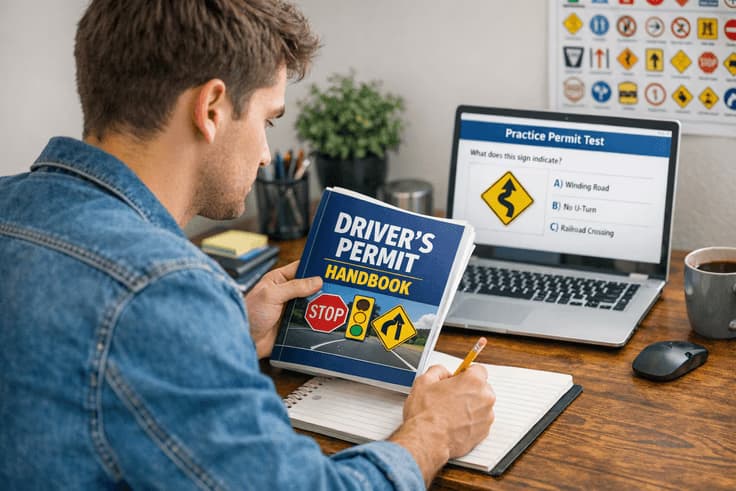
Here's what catches people off guard after they pass their new york city permit practice test:
- Right-of-way isn't always "given" - legally it's yours, but hesitating confuses everyone and can actually make things more dangerous
- You need to plan two moves ahead, not ten - if you need to turn left soon, start positioning earlier than feels natural
- Blocking the box is a real problem in NYC intersections, and it earns you both a ticket and the fury of cross-traffic drivers
This one trips people up.
Small detail worth noting: on the written exam, two answers often look right. On the actual street, two choices feel right. Time pressure makes you misread both situations, just differently.
The NYC Rules That Get People Ticketed
Some tickets in the city come from habits that are perfectly fine upstate. In Syracuse or Utica, certain things don't even register. Here, they're enforced.
Pay attention.
- No right turn on red anywhere in NYC unless a sign specifically says you can - this is the reverse of what most people assume
- Handheld phone use is illegal even while stopped at a red light
- Wipers on means headlights on - if it's raining and you're running wipers, your lights need to be going too
This one trips people up.
And the Move Over law applies statewide, including in the city. You must slow down or change lanes for emergency vehicles, tow trucks, and vehicles with amber lights. On the Cross Bronx or the LIE, that means slowing more than feels comfortable. Do it anyway.
How to Handle Aggressive Drivers in NYC
You will not win against aggressive drivers. Not worth trying. You can only avoid getting sucked into their bad choices.
Stay calm.
What actually works, whether you're in Brooklyn, Queens, Manhattan, or the Bronx:
- Don't respond to honking by making sudden moves
- Signal early and commit when you have a safe gap
- Always leave yourself an escape route, even crawling in traffic
This one trips people up.
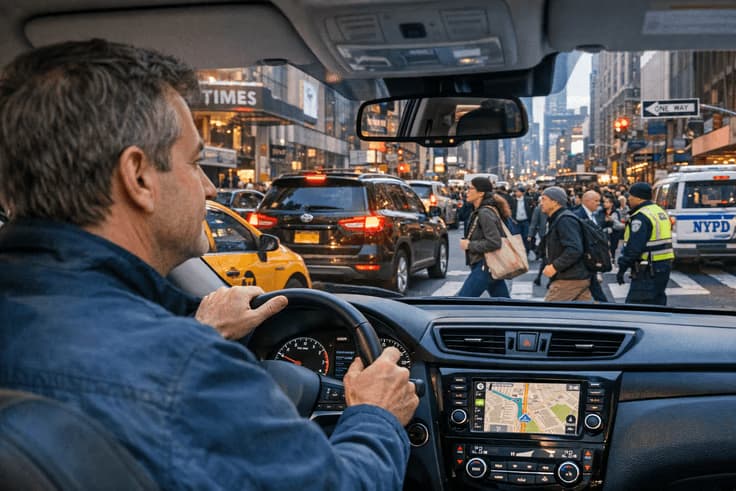
Defensive driving here isn't about being timid. It's about being predictable. If you're unsure, slow down smoothly. Don't slam the brakes unless you absolutely must. And don't race anyone to prove a point - somebody out there will always be willing to drive worse than you.
Let them go.
Parking and Navigation Challenges
Parking is where new driver confidence goes to die. Especially in Manhattan.
Street spots are scarce. Signs are layered and dense. Alternate-side rules feel like solving a riddle. In parts of Brooklyn and Queens, you're also dealing with tight gaps and fire hydrants every few car lengths. Staten Island is more forgiving, but don't just assume.
Read everything.
What actually helps:
- Practice parallel parking on a quiet street first, then gradually increase difficulty
- Learn to spot legal spaces quickly without panic-braking
- Use mirrors first, then physically turn your head anyway
This one trips people up.
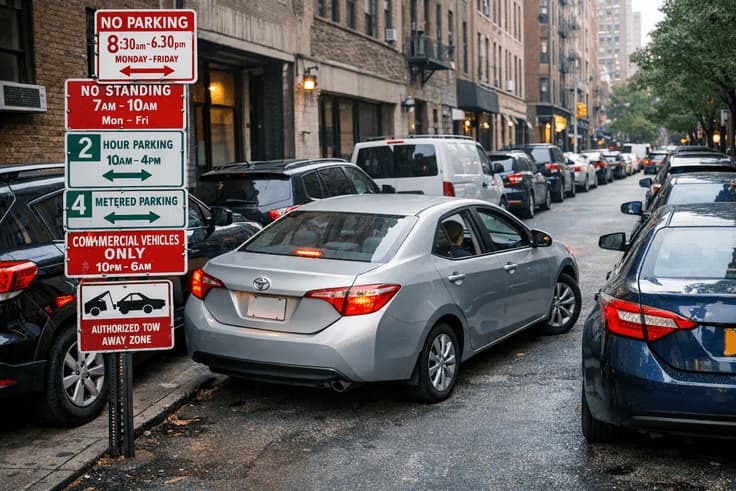
Navigation is trickier than people expect because the city has a flow to it. One wrong lane and you're being pushed toward a bridge or tunnel entrance you didn't want. If GPS says "keep left," do it well before the last two hundred feet.
Too late is common.
Tips for Driving Safely in NYC
Safety here is about anticipation. You're not just reacting to mistakes. You're predicting them before they happen.
Expect stops.
Keep a bigger following distance than the car next to you. Yes, even in crawling traffic. The second someone double-parks ahead, the car in front of you may stop dead. You want enough room to brake without getting hit from behind.
Scan crosswalks constantly. New York law requires yielding to pedestrians in marked crosswalks, and in practice you'll also see aggressive jaywalking. Assume someone will step off the curb the moment the light changes.
Watch the curb lane closely. That's where bikes, scooters, delivery workers, and sudden door openings live. "Dooring" is a real thing and it happens fast.
Stay patient.
One more thing: many NYC-area parkways have low clearances and ban commercial trucks entirely. If you're driving a rented van or a moving truck, plan your route carefully or you'll learn this the hard way at an overpass.
How to Transition from Test Knowledge to Real Driving
The DMV materials are a foundation. Now you need repetition.
Start simple.
Drive quieter areas first. Early mornings in parts of Queens or wider streets on Staten Island make a good bridge before you attempt Midtown gridlock. If you're coming from upstate - Schenectady, Albany, wherever - give yourself a few low-pressure drives before jumping into Manhattan.
Then layer in complexity. Busier hours. Routes with more one-ways. Bridges. Then parking.
One step at a time.
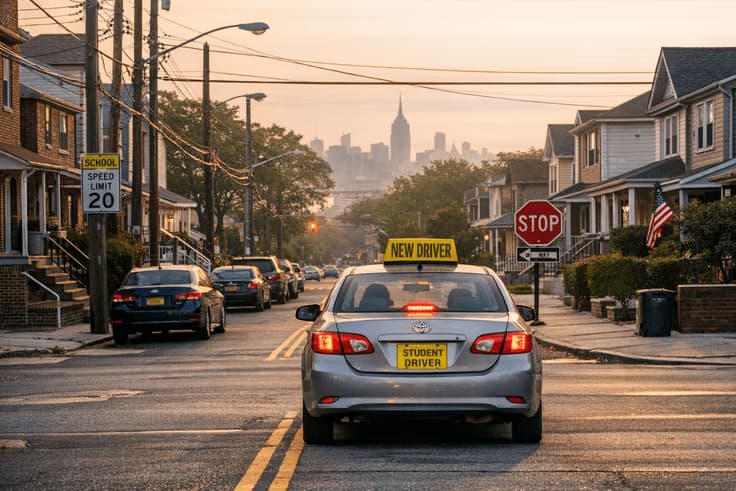
If you're still getting ready for the ny state driving test, remember the examiner is looking for control, observation, and legal decision-making. Actual city driving adds speed of decision. You can practice that safely by narrating what you see out loud: "pedestrian near curb," "car door might open," "stale green," "bike on right." Keeps your brain ahead of the vehicle.
It works.
And finally - accept small mistakes. Missing a turn. Picking the wrong lane. Taking an extra loop around a block. All normal when you're driving in NYC for the first time, or the fiftieth. The goal is to stay legal, stay calm, stay predictable, and correct as you go.
You'll get there.
Share