Crossbuck Sign (Railroad Crossing): Meaning, Shape, and DMV Test Tips
Out of all the signs I quiz students on, the railroad crossing crossbuck sign is maybe my favorite, that white X with RAILROAD CROSSING on it, planted next to the tracks. Tracks. A train. A decision you have to make in about two seconds. That is the crossbuck. It isn't just a warning. It's a regulatory sign. The law treats it like a yield sign. A lot of my students didn't know that when they started with me, and the permit test asks about it pretty often. You'll pass a bunch of them, since there's one at nearly every public highway-rail grade crossing in the US (I cross a few just driving to work).
What Does the Crossbuck Sign Mean?
The crossbuck sign meaning is yield. You yield to any train that's coming. So what does a crossbuck sign mean when you actually roll up to one? It means the train goes first, and I don't care if you got there before it did. Ever. Picture a freight train for a second, all those cars. That thing can't steer around you, and stopping takes it forever, so staying out of its way is your job.
You'll find the railroad crossing sign where the road actually meets the tracks, about where your tires would thump over the rails. It is not the yellow circle you saw a few hundred feet back. That was the advance warning. This is the real thing. If a train is near, you stop. If you try to beat it and cross in front of it, that is a serious moving violation. Not a small fine.
I always tell students the sign isn't asking you for a favor. It's telling you the train has the right of way (and you don't).
What Does the Crossbuck Sign Look Like?
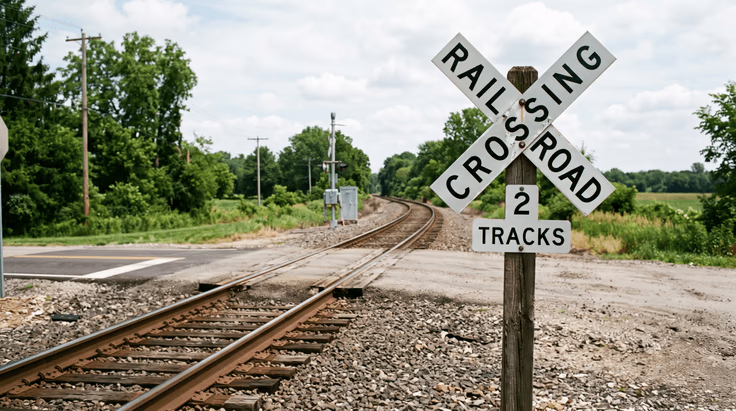
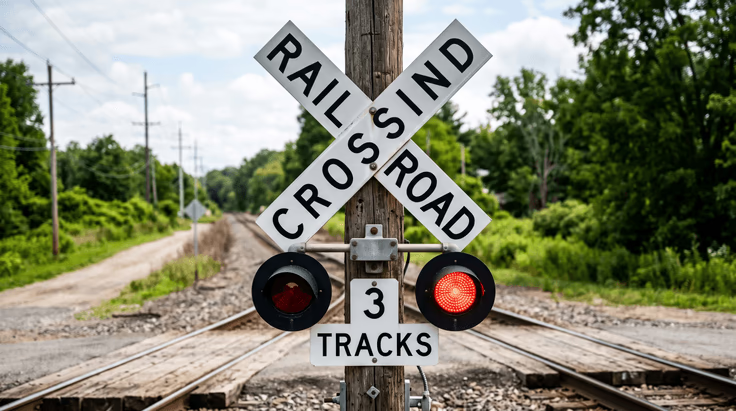
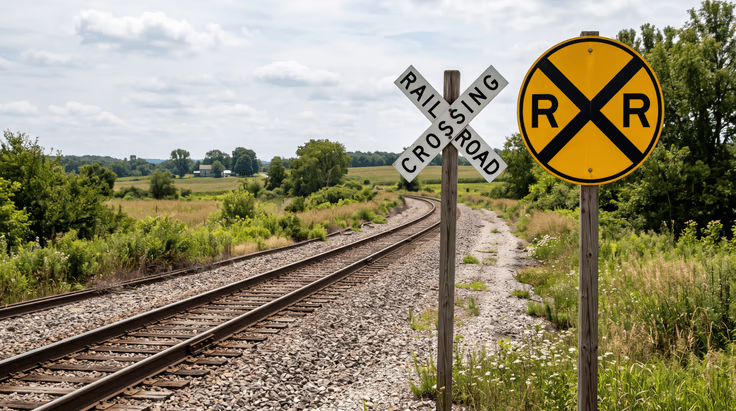
It's just two white boards nailed up in an X, with RAILROAD CROSSING across them in black. That X shape is reserved for rail crossings only. No other road sign uses that X shape.
In busier areas you'll often get red flashing lights with it, sometimes a gate that swings down across your lane, and usually a bell clanging away while the lights go.
Out in the country, or back in an industrial park full of warehouses, you'll find plenty where the crossbuck is the only thing there. No lights. No gate. Just the white X and your own judgment.
Those bare ones are the crossings I worry about most with new drivers, honestly. Nothing is flashing at you there, so some people roll right over without looking, and I don't want you doing that.
What Should You Do at a Crossbuck Sign?
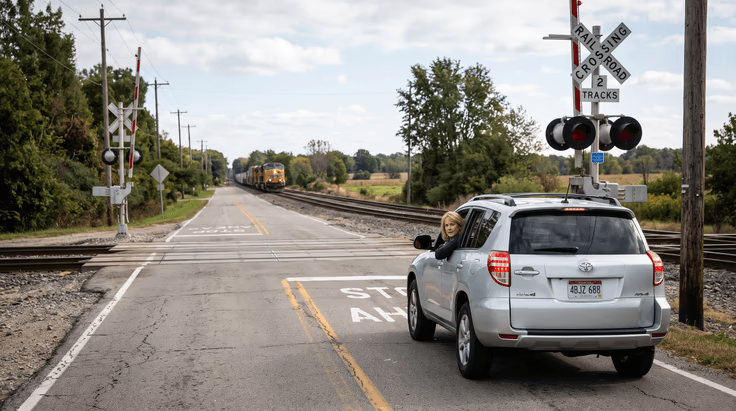
The crossbuck road sign rules say to slow down as you get close and be ready to stop. Look left and right. Listen. If a train is coming, stop at least 15 feet from the nearest rail.
Never stop on the tracks. Sit there and let the whole train go by, all the way to the last car. Check both directions again. There could be a second train on the other track heading the opposite way, hidden behind the first one, so you only go once both directions are empty.
When I'm in the car with a student, I have them turn the radio down before a crossing. Half the time you'll hear the horn before you see anything, at least if trees or a building are blocking your view.
Crossbuck Sign vs. the Round Railroad Advance Warning Sign
People mix these two up all the time. The round yellow RxR sign warns you in advance. You see it before the tracks. It tells you to prepare.
The crossbuck is at the tracks. It tells you to yield. The DMV written test loves to ask which sign actually requires you to yield. The answer is the crossbuck. The yellow sign just warns you. The white X commands you.
So when you pass that yellow circle, use it as your cue to slow down a bit and start looking. The white X at the rails is the sign you have to obey. On the test, if the picture shows the round yellow sign, the answer is usually about slowing down and getting ready. If it shows the white X, the answer is about yielding to the train.
Where Are Crossbuck Signs Used?
You'll find one at nearly every public highway-rail grade crossing in the US. They show up on rural roads and city streets, and in industrial areas too.
You'll usually spot one on each side of the road at the crossing, so traffic from either direction gets its own sign.
The crossbuck has to be there even at crossings that have no gate, no lights and no bell at all. That is important. A quiet crossing with no lights can still have a train coming from either direction. I still look both ways at those, even ones where I've never once seen a train go by. You can't guess when a train will show up, and near a factory or a rail yard I've seen slow ones creep through at odd hours.
DMV Test Tips for the Crossbuck Sign
A crossbuck legally equals a yield sign. That is the fact the test wants you to know. Trick answers will claim you may proceed even if a train is near. Wrong. You wait.
The X shape is your quick cue. X means railroad. Every time. No exceptions.
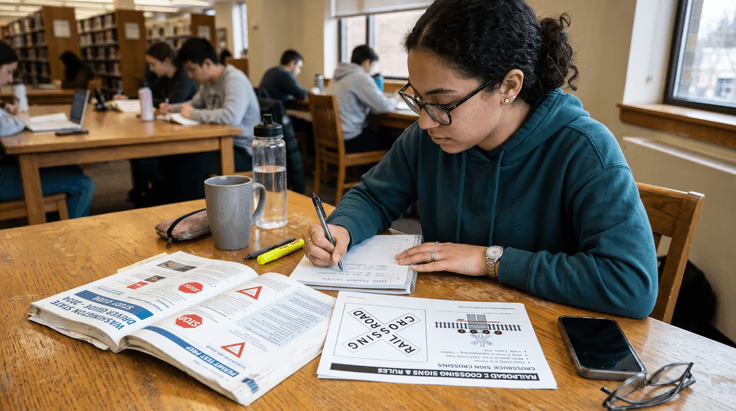
When you study, picture the sign in your head and say out loud what you'd do. I make my students do that in the car and they always laugh at me, but it works. The test may show a crossbuck and ask what to do. The common mistake is rolling onto the tracks without checking both directions. Two answers look right. One says slow down and proceed. The other says stop and yield. Choose the answer that says stop and yield.
If you see a question about the round yellow sign instead, remember that one only warns you the tracks are ahead. The question that asks which sign means you must yield is always pointing you at the white X.
Crossbuck Sign FAQ
Is a crossbuck sign the same as a yield sign? Legally, yes. It has the same meaning. You must yield to trains. Treat the train like cross traffic at a yield sign, it gets to go and you hang back.
Do I have to stop at a crossbuck when there's no train? No. You stop if there's a train on the way, or if the lights or gates are going. If not, slow down, take a look each way, listen, and then go on over.
How far back should I stop if a train's coming? Stay at least 15 feet from the closest rail, and keep your front bumper behind that line.
Can you pass another vehicle at a railroad crossing? No. Passing anybody within 100 feet of a railroad crossing is illegal, so just sit behind whoever's in front of you.
What if the lights flash but the gates haven't come down? Stop. Those lights mean a train's on the way. And don't ever go around the gates.
Where does the name crossbuck come from? The two boards make an X, and people thought that looked like an old sawhorse, which some folks used to call a "buck."
Do quiet back-road crossings still get a crossbuck? Yes. Yep, a public crossing needs a crossbuck even if it's got no gate and no lights. A plain white X out on some farm road means just what it means in town.
That X shape sticks in your memory. Recognize the crossbuck instantly. When a train's anywhere near that crossing, it goes first and you wait.
Share