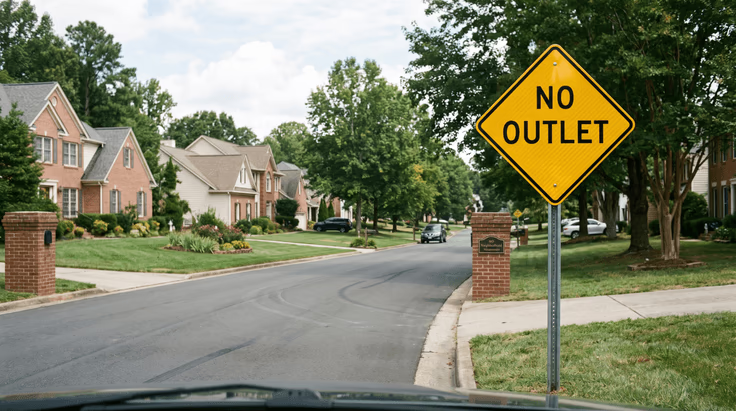
No Outlet Sign: Meaning, Shape, and DMV Test Tips
The no outlet sign meaning is direct. The streets past it don't go through to any other road, so you drive back out the way you came in. Permit tests like to put it next to a dead end and ask which is which.
What Does the No Outlet Sign Mean?
The no outlet sign warns that the roads ahead have only one entrance. You can drive in. You must leave the same way. There is no through route.
It covers a group of streets, not one road. Say a subdivision has three or four cul-de-sacs off one entry street. You can drive around in there as long as you like and you still end up back at that entry street.
I tell students to picture a parking garage with one ramp. You can go up a level and come down another aisle and you still leave by that one ramp. The sign goes at the entrance so you know before you turn in.
What Does the No Outlet Sign Look Like?
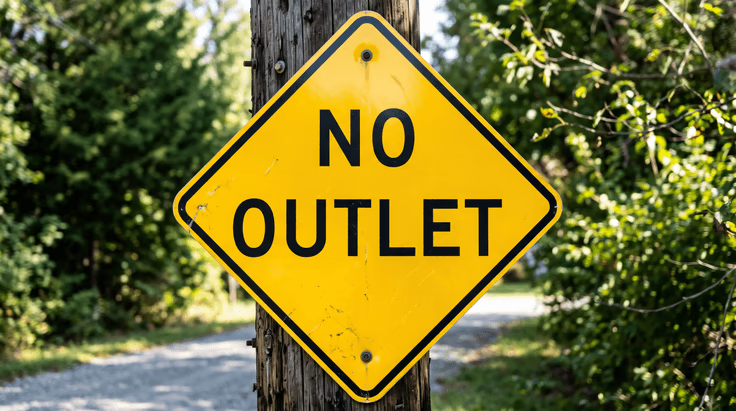
It's a yellow diamond, the same shape as most warning signs. The words NO OUTLET appear in black letters on the yellow field. No symbol, no arrow. Just words.
This is a word-message sign, not a symbol sign. The DMV uses it because the message is direct. Yellow means warning. Black means read this now.
Yellow and black is the normal warning color code, so read it as a heads up about the road, not a rule. It doesn't say you can't go in. It's just giving you information before you commit, which honestly is pretty considerate of whoever put it up.
What Should You Do When You See a No Outlet Sign?
Ask yourself one quick question, which is whether the place you're going is actually somewhere in that neighborhood, and if it is, go right ahead. If you are just cutting through, do not enter. You will not come out the other side.
Expect to backtrack. You'll leave by the same route you entered.
You can't cut through to another street. No through route exists.
When you do need to get turned around in there, a turnaround circle at the end of a cul-de-sac is the easiest spot, and a driveway works too as long as you're careful about kids, bikes and mailboxes (I've watched plenty of students clip a trash can doing this on a road test).
Slow down a little once you're past the sign too. These are almost always residential streets, so people back out of driveways without looking much, kids play near the curb, and delivery vans stop wherever they please. You're not in a hurry in there anyway, since you can't go anywhere but back out.
If you're following GPS and it sends you past a no outlet sign, it's worth a second look. Most of the time the app knows the address is inside, but now and then it's just wrong, and I'd trust the sign over the phone every time.
No Outlet Sign vs. Dead End Sign
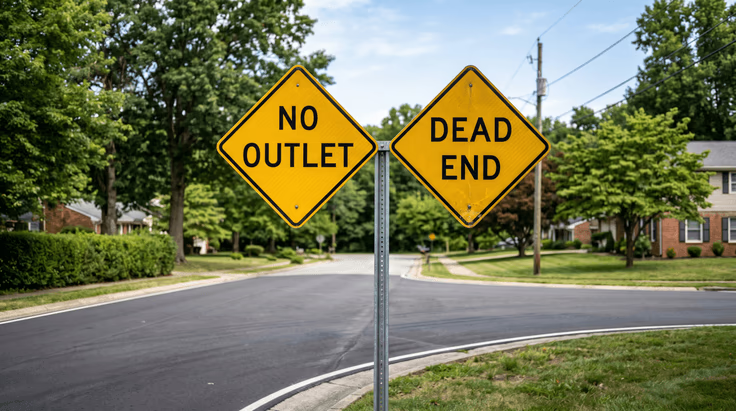
Here is where permit tests get sneaky. Plenty of people think these two signs are just two ways of saying the same thing, and they really aren't.
The dead end sign is about a single road, one street that just stops somewhere up ahead. One road. No outlet.
A no outlet sign means a group of roads with one entrance. There may be side streets, loops, and turns. But none of them connect to another through road.
Two answers look right. The test knows that.
So here's how I'd keep them straight. A dead end is a hallway with a wall at the end, and a no outlet is a whole apartment with several rooms but only one front door. In both cases you're coming back out the way you went in, but the no outlet area gives you more streets to drive around before that happens.
Where Are No Outlet Signs Used?
Look for no outlet signs at a subdivision entrance. You'll also see them at an apartment complex entrance. Hillside neighborhoods get a lot of them as well, because the streets climb and wind and there's usually just no room to punch a second road out the back. Every street winds back to one main road. Private road networks use them too.
Cul-de-sac clusters are the classic example. Several short streets branch off one entry road. No other exit.
You'll also run into them in some rural spots, like a set of gravel lanes around a lake or a group of farm roads off a county highway, where the only paved connection is the one you turned in on. Same meaning, it just looks different out there.
The streets behind a no outlet road sign get almost no through traffic, so they're usually quiet, and I'd drive them slow.

DMV Test Tips for the No Outlet Sign
The DMV wants you to know one thing. A no outlet sign means a network with only one way out.
Contrast that with a dead end. A dead end is a single stopping road.
Quick cue: the words NO OUTLET on yellow. If you see that, think "neighborhood trap."
A lot of students lose this point by picking the dead end answer out of habit. A test question may describe side streets with one entrance. Choose the answer about a one-exit network.
Read the full question first, then the choices. If it mentions several streets, a subdivision or a group of roads, you're in no outlet territory. If it talks about one road ending, that's your dead end answer. I'd also watch for picture questions where the sign is shown with no words visible, because then you've got to go by context, and the diamond shape alone won't tell you which one it is.
And it's a warning sign, not a regulatory one. If an answer says you're not allowed to drive in, that answer is wrong.
No Outlet Sign FAQ
What does a no outlet sign mean? It means the streets past the sign don't link up with any other road, so you'll have to come back out the same way you drove in.
Is a no outlet sign the same as a dead end? No. A dead end is one road that stops. A no outlet applies to a group of roads with one entrance.
What color is a no outlet road sign? Black letters on yellow, on a diamond. That color marks a standard warning sign.
Where will I see a no outlet sign? At the way into a subdivision, a group of cul-de-sacs, a private road network or an apartment complex.
What should I do at a no outlet sign? Enter only if your destination is inside. Otherwise, stay out. Plan on driving back past this same sign when you leave.
Why does the DMV test ask about no outlet vs dead end? People mix them up all the time, so the test checks it. A dead end is one road. A no outlet covers a road network.
Can I turn around in a driveway? You may, if you have no other choice. Don't block traffic. Don't enter private property without need.
Does a no outlet sign mean I'm not allowed in? Nope. Anyone can drive in. It's a warning, not a restriction, so go ahead if your stop is in there.
Share