Slow Moving Vehicle Sign: Meaning and DMV Test Tips
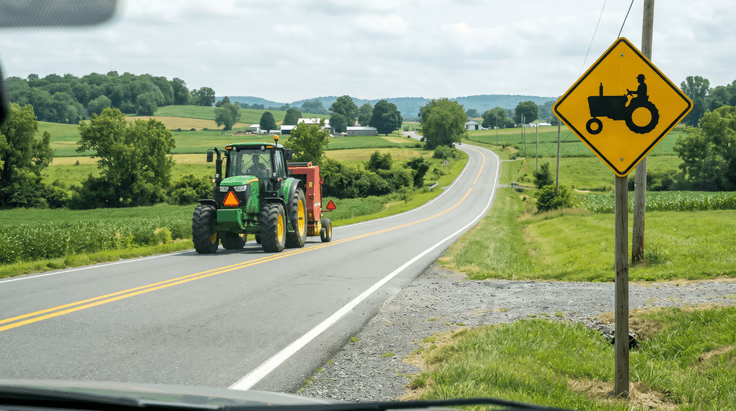
When you pass a slow moving vehicle sign, somewhere up the road there's probably a truck or a piece of equipment crawling along way under the speed limit. Put it in a work zone and it turns orange, and then I'd be watching for dump trucks, pavers or a maintenance crew pulling out into your lane. On the permit test they mostly want to know you'll slow down and only go around when it's actually safe.
What Does the Slow Moving Vehicle Sign Mean?
What does slow moving vehicle sign mean? Put simply, the slow moving vehicle sign meaning is that you're about to catch up to something going a whole lot slower than everybody else, maybe a farm tractor, maybe a paver, maybe a county maintenance truck, and plenty of them top out around 25 mph or less.
It's a warning.
You need to expect a sudden drop in traffic speed. On a rural highway outside of Fresno or Bakersfield, that can happen fast. One second you're cruising, the next you're behind a hay baler. The sign gives you time to react.
- Warns of vehicles moving well below the speed limit
- Could be a tractor, a paver or a road crew truck
- Expect a sudden drop in traffic speed ahead
- Prepare to slow and follow safely
A lot of my students figure "slow" means tap the brake a bit and carry on. No. Think about rolling along at 55 and topping a hill onto a tractor doing 25, that's a 30 mph difference and it closes up quicker than you'd believe.
What Does the Slow Moving Vehicle Sign Look Like?
It's a diamond warning sign. Standard shape. Out in farm country you'll usually see it in yellow with a black truck or tractor drawn on it. In work zones, it turns orange.
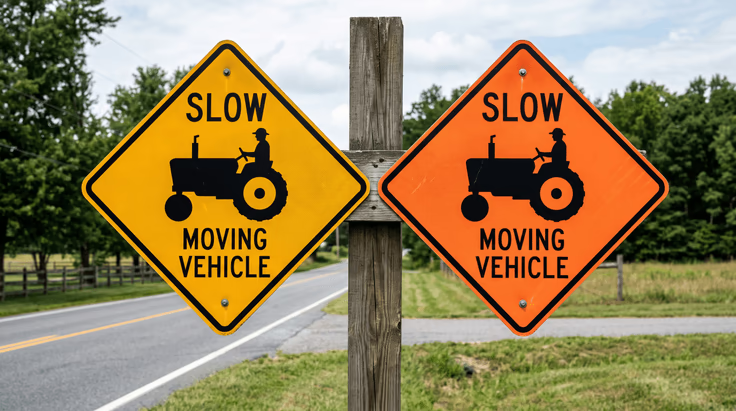
Orange means temporary. Construction. When I see orange I assume a crew is working there today and might not be there next week.
Now, the sign and the reflective SMV emblem are not the same thing, and the test knows people mix them up. The emblem is an orange triangle mounted on the back of a tractor. The sign stands on the roadside. Both may be orange, but they are different devices.
A slow moving vehicle road sign gives you a heads-up before you can even see the vehicle. The emblem tells you this specific vehicle is slow. Two separate tools.
What to Do When You See the Slow Moving Vehicle Sign
The first thing I'd do is get off the gas, gently, without stomping the brake, and let the gap in front of you open up, since that slow vehicle might be sitting just around the next curve or over a rise where you can't see it yet.
Then keep an eye on the shoulders and driveways, because equipment likes to pull onto the road or cut straight across it. Construction entrances near highways may hide a paver about to pull out. I've had a loaded gravel truck roll out of a haul road in front of me with maybe a hundred feet to spare, and it wakes you right up.
And if you want around it, wait for a stretch where passing's legal and you can see a long way down the road. On a two-lane highway, a few minutes behind a tractor beats a head-on crash every time (I'd take the extra few minutes).
- Ease off the accelerator and increase following distance
- Be ready for equipment entering or crossing the road
- Pass only where legal and with a clear sight distance
- Do not tailgate slow trucks or machinery, since the driver often can't see you back there and loose gravel or mud can fly off the load
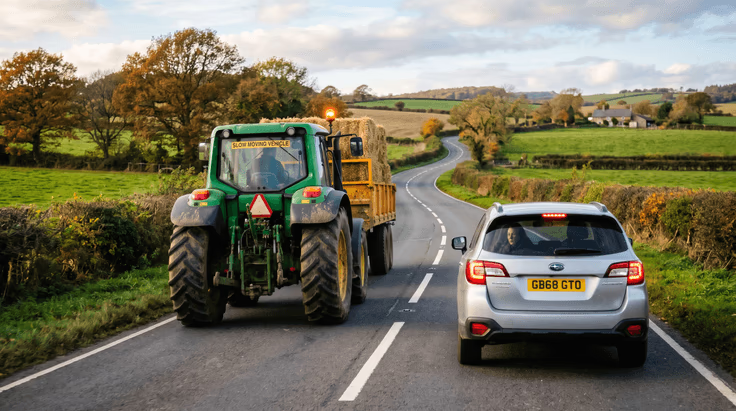
You'll probably see "reduce speed" sitting next to "stop immediately" on the test, and stopping dead on a highway because of a sign is how you get rear-ended, so skip that one. The right answer is always slow and follow safely.
Slow Moving Vehicle Sign vs. the SMV Emblem
I already touched on this, but it's worth repeating because the DMV test loves this comparison.
The slow moving vehicle sign is a roadside warning. It tells you slow vehicles may be ahead. The SMV emblem is an orange triangle mounted directly on the back of tractors, combines, and other equipment that can't go over 25 mph. It's reflective so you see it at night from a distance.
One is a warning of a possible hazard. The other is the hazard itself.
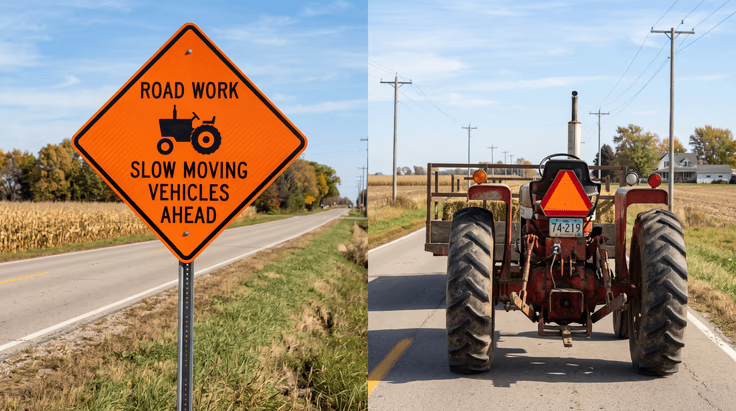
If a test question shows a picture of an orange triangle on a vehicle and asks what it means, don't pick "slow moving vehicle sign." That's the emblem. The DMV uses wording to test the difference.
Where the Slow Moving Vehicle Sign Is Used
You won't find the slow vehicle ahead sign just anywhere, it goes up where slow traffic is actually expected.
I see it most near construction entrances and haul roads, where a dump truck loaded with dirt or gravel needs a good long while to get up to speed after it pulls out. You'll also spot it where heavy equipment has to drive in the travel lanes to get from one part of a job to the next. It is common on rural routes with farm traffic during planting or harvest. Highway 99 through the Central Valley is one example.
And in work zones with slow-rolling operations, like line painting or crack sealing crews.
The orange version is almost always temporary. The yellow version is permanent. If the DMV shows you a picture, odds are it's the orange work-zone one.
DMV Test Tips for the Slow Moving Vehicle Sign
The DMV doesn't really care if you can name this sign, they want to see what you'd do about it. They ask practical ones.
For this sign, the right answer is almost always "slow down and follow at a safe distance." Not "change lanes immediately." Not "honk." Not "speed up to pass quickly."
Don't mix up the sign with the orange SMV triangle emblem. If the question says "mounted on the back of a vehicle," that's the emblem. If it says "on the side of the road," that's the sign.
- Right answer is to slow down and follow at a safe distance
- Do not mix up the sign with the orange SMV triangle emblem
- Orange version signals a work-zone hazard
- Pass slow vehicles only when it is legal and clear
So read the question slowly and look for words like "mounted on the back of a vehicle" or "side of the road." That tells you which device the question means. Then match the answer to that device. The DMV knows people skim.
Slow Moving Vehicle Sign FAQ
Is the slow moving vehicle sign always orange? No. It's yellow in normal conditions and orange in work zones.
What speed is considered slow moving? Generally anything going 25 mph or under, which lines up with the vehicles that have to carry the SMV emblem in the first place.
Do I have to stop when I see this sign? No. Just come off the gas and give yourself more following distance, because stopping in a travel lane is a good way to get hit from behind by the car that wasn't paying attention.
Can I pass a slow moving vehicle on a double yellow line? That depends on where you're driving. Some states allow passing farm equipment on a double yellow. Even there you'd need a clear view way down the road and equipment that's crawling, so look up your own state's driver handbook before you try it.
What's the difference between the sign and the emblem? The sign is on a post by the road and warns you before you get there. The emblem is on the vehicle. Both mean slow down, but they're different devices.
Will this sign be on my permit test? Probably. It's a common warning sign question, especially the orange work zone version.
What should I do if I'm behind a slow moving vehicle at night? Use low beams when close. Keep extra distance. I'd only pass at night if you can clearly see the road's empty well ahead, and keep watching for that reflective orange triangle, which lights up in your headlights long before you can make out the tractor itself.
The slow moving vehicle sign is basic. But basic signs are the ones people miss because they don't study them. Follow safely. Pass legally. That's it.
Share