Dead End Sign: Meaning, Shape, and DMV Test Tips
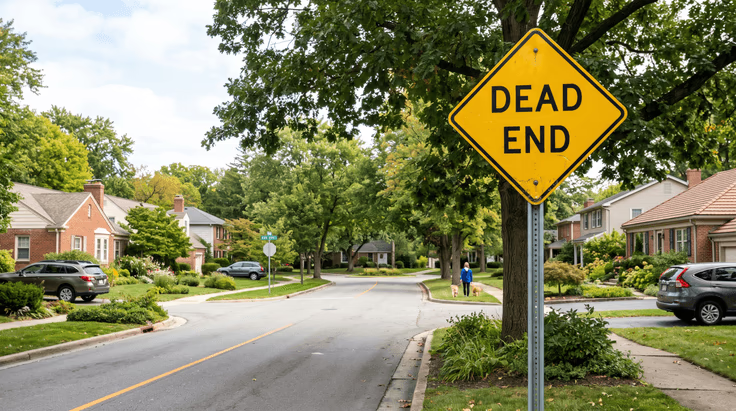
You see the yellow diamond and the words DEAD END. That's it. The road ahead stops. There's no way through to another street. So whatever's down there, a few houses or a gravel turnaround or a gate across a field, sooner or later you're going to be turning the car around and coming back out the way you came in.
The sign usually goes up where one road just runs out, and the permit test likes to use it to see whether you can tell it apart from the no outlet sign, which I'll get to in a minute.
What Does the Dead End Sign Mean?
The dead end sign meaning comes down to this, the road you're about to drive on stops somewhere ahead and doesn't hook up with anything else. The road terminates. It doesn't connect to another road. You'll turn around at the end. Look for a driveway or cul-de-sac. There's no exit onto a main route.
The test checks these four points:
- The road ahead ends and does not connect through
- You will need to turn around to leave
- No exit onto another road at the end
- Often a single street that simply stops
Don't confuse a single stopped road with a no outlet network. Expect at least one question built around that exact mix-up, because it's the one I see students get wrong most.
What Does the Dead End Sign Look Like?
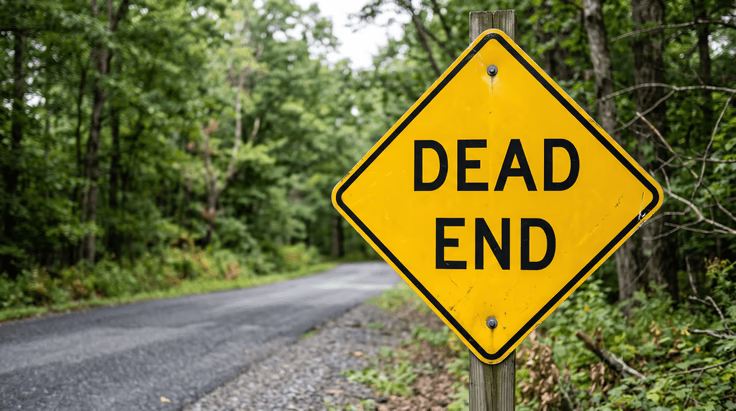
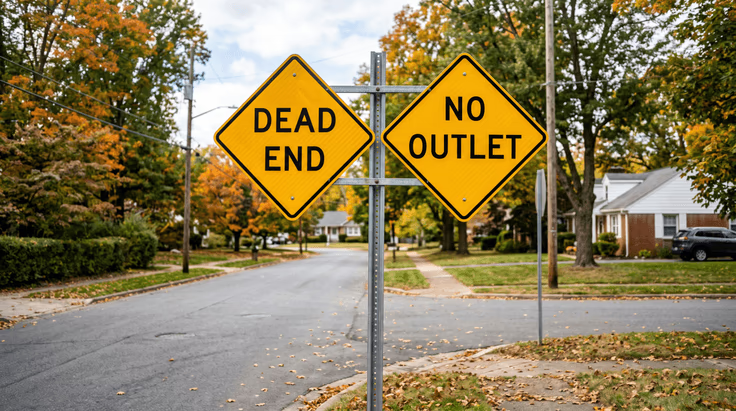
What you're looking for is a dead end road sign shaped like a diamond and painted yellow, the same shape and color as the curve and deer crossing signs you already know. Yellow diamond shape with a black border. The words DEAD END appear in black letters on the yellow background. No picture, no symbol. Just words.
That word message format is important. The DMV wants you to recognize it instantly. Most warning signs use symbols, but this one uses text because there's no universal icon for "road stops ahead." The yellow does the same job it does on every other warning sign, it's telling you to ease up and pay attention to what's coming, even though nobody's ordering you to do anything.
What Should You Do When You See a Dead End Sign?
Nothing about the sign tells you to stop, so you can keep rolling past it like any other warning sign. But you should plan. It won't take you anywhere except to the road's end. The route just ends.
Once you've seen it, here's how I'd handle the road ahead. Start figuring out where you'll turn around well before you run out of pavement, and keep an eye out for a driveway, a wide shoulder or a cul-de-sac where you can do it without backing a long way. Do not expect a through connection, and slow down as the road gets near its end.
If you turned in by accident (I've done it plenty of times following a GPS on country roads), there's no shame in it. Just turn around carefully, check for kids and parked cars on the residential ones, and head back out.
Time pressure makes you misread signs like this on a test. You see DEAD END and your brain jumps to NO OUTLET. The difference is dead end vs no outlet.
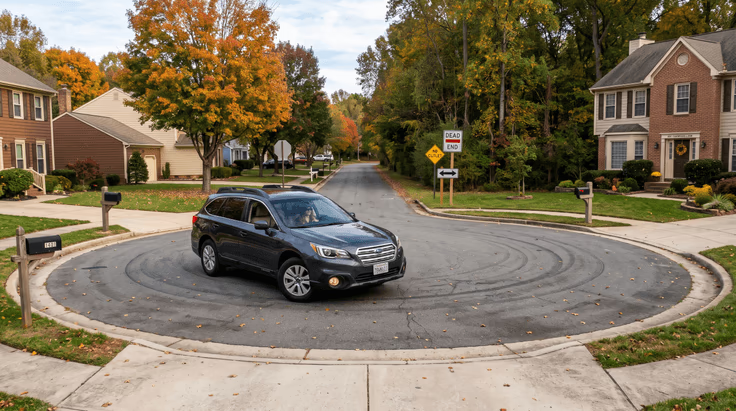
Dead End Sign vs. No Outlet Sign
This is where most permit test mistakes happen. The dead end sign refers to a single road that stops. One street. It ends. You turn around.
A no outlet sign refers to a network of streets. Think one street versus a small network. A small neighborhood may have many connecting streets. But the whole area has only one exit.
So:
- Dead end: a single road stops.
- No outlet: a group of roads with only one way out
- Dead end has no branching escape
- Test often pairs these two signs
On the test, you'll see both signs in one question. Tell them apart by the road network.
The way I explain it to students is to picture a subdivision with a single way in off the main road. Inside, the streets loop and branch, and you could drive around in there for a while, but every route eventually brings you back to that one entrance. That's no outlet. A dead end is a lone street that goes a little way and stops, and there's nowhere to branch off along it.
Where Are Dead End Signs Used?
You'll usually spot a dead end road sign right where you'd turn onto a road that runs out, and a lot of the time that's a quiet street with houses on it. Out in the country you'll see them on lanes that stop at somebody's property line or a farm gate. Now and then a road gets blocked off because of construction or because there's a river or a hill in the way, and the sign goes up at the start so you know before you're halfway down it.
Common locations:
- At the entrance to a road that terminates
- Quiet residential streets
- Rural lanes ending at property lines
- Roads closed off by construction or geography
The sign is placed before you commit to the road. You see it before you enter the road. The decision happens before the turn.
So when you see it at an intersection, that's your moment to decide whether you actually need to go down there. If you're just looking for a way through to the next street, keep going and pick a different turn.
DMV Test Tips for the Dead End Sign
The DMV test asks about this sign often. It looks simple but causes mix-ups. A question may show a road that simply stops. The test checks the difference between dead end and no outlet. They also want to see if you know what action to take.
Remember this:
- Key idea: the road stops, turn around
- Contrast it with no outlet, a network with one exit
- Quick cue: the words DEAD END on yellow
- Common mistake is mixing it up with no outlet
May vs must matters on written tests. Nothing on the sign makes you turn around the second you pass it, what it's really saying is that a turnaround is coming at some point and you'd better be ready for it. The turn comes at the road's end, not immediately.
When you read the answer choices, I'd cross out anything that says stop, yield or turn around right away, because those are things a regulatory sign would tell you to do. Then pick the one about the road ending ahead.
Dead End Sign FAQ
Is a dead end sign the same as a no outlet sign? Nope, they're different signs. A dead end means one road stops. A no outlet means a group of roads has only one exit.
What color is a dead end sign? Yellow with black lettering, same as the rest of the warning signs, and that yellow is your cue to slow down and pay attention.
Do I have to stop at a dead end sign? No. It's only a warning and not a regulatory sign, so there's no stop required, it's just letting you know the road runs out somewhere up ahead.
What if I drive past a dead end sign? Then you'll get to the end of the road and have to come back around. Nobody's going to ticket you for it, it just costs you a few minutes and a bit of gas.
Can a dead end road have a cul-de-sac? Yes. Lots of them finish in a cul-de-sac or some kind of turnaround spot. That makes reversing easier.
Why does the DMV test ask about dead end signs? Because new drivers often confuse dead end with no outlet. They're checking that you can look at the two signs side by side and say which one is which.
What does a dead end sign mean on a permit test? The road ahead ends. You can't drive through to another street. You'll have to turn around.
Share