Right Turn Sign (Sharp Turn Warning): Meaning, Shape, and DMV Test Tips
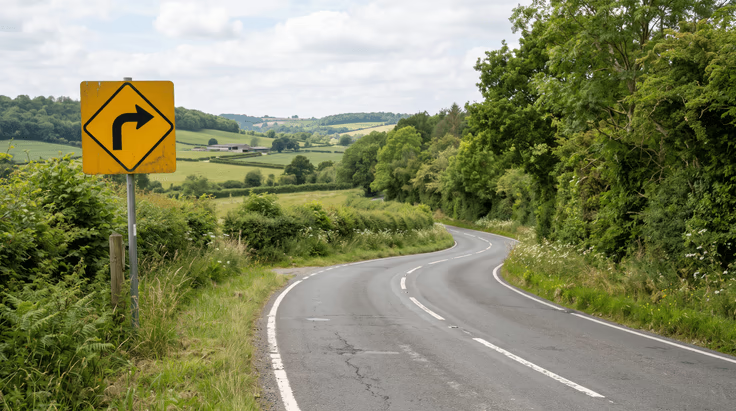
Put plainly, the right turn warning sign meaning is that a sharp bend to the right is coming up on you. It's yellow, diamond shaped, and they put it up early enough that you've got a few seconds to get ready. The arrow doesn't curve gently. It bends at a hard right angle. That's the whole message. The road ahead doesn't meander. It turns.
My students hear this from me on day one. There's a tight turn coming that you can't take at full speed, and the permit test uses this sign to see if you'd slow down early or wait till you're already in the bend (which is the wrong answer, every time).
What Does the Right Turn Sign Mean?
Short version, the road's about to hook hard right. Not a soft curve. Not a highway ramp.
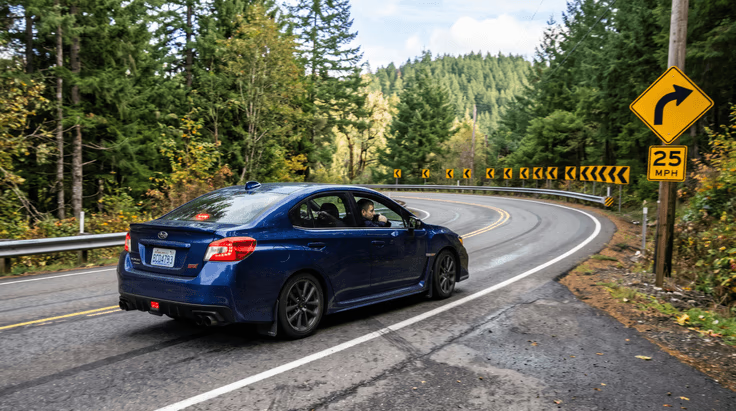
This bend is way tighter than your average gentle curve, so your speed has to come down and you've got to think about where the car sits in the lane, and I want all that slowing done before you get there, not halfway around. Some locations add an advisory speed plaque below the sign. So if you see 25 mph on there, that's what a normal car is supposed to manage on dry pavement, and I'd take it as the most you should be doing, honestly.
Picture why the sign got put up in the first place. Most of the time a hill or a bunch of trees hides the bend until you're nearly in it, and drivers kept getting caught out there. You got a heads-up, so go ahead and use it.
What Does the Right Turn Sign Look Like?
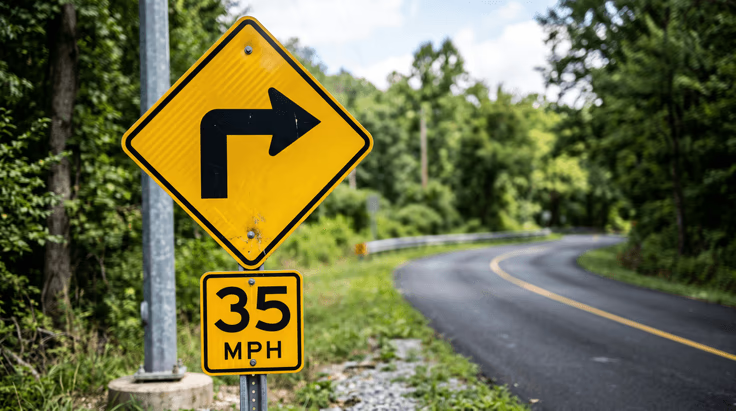
Look for the yellow diamond with a fat black arrow that runs straight up and then cuts right at a right angle, pretty much a square corner, and that's why folks call it the sharp right turn sign. The diamond shape makes it a warning. It isn't a regulatory command.
You might see a smaller rectangular plaque below the diamond with a speed number. That's the advisory speed. Out on some older back roads there's no plaque at all, and then it's on you to size up the turn and pick a speed.
Pay attention to the arrow itself, because that's the whole sign. It's bold, it's simple, and the corner in it is square, not rounded. If you see a smooth swoop instead, you're looking at a different sign (more on that below).
What Should You Do When You See the Right Turn Sign?
Do these when you see the right turn sign:
- Ease off the gas before the turn.
- Brake before the bend.
- Get your braking finished before the turn starts, not in the middle of it.
If you're hard on the brakes halfway through a tight turn, weight shifts forward off the back tires and the rear can start to slide on you.
Keep the car on the right side of your own lane the whole way around, since carrying too much speed is what drags you over toward the center line (and toward whoever's coming the other way). Once the wheel's straight again, then you can ease back on the gas, which lets the front tires get their grip back before you ask anything more of them.
I'd start lifting off the gas the moment you read the sign, well before the turn itself. By the time you're at the bend, your foot should already be done with the brake, your eyes should be looking through the turn to where you're headed, and your hands should be smooth on the wheel. If you've got that order right, the turn feels boring. Boring is what you want here.
Right Turn Sign vs. the Curve Sign
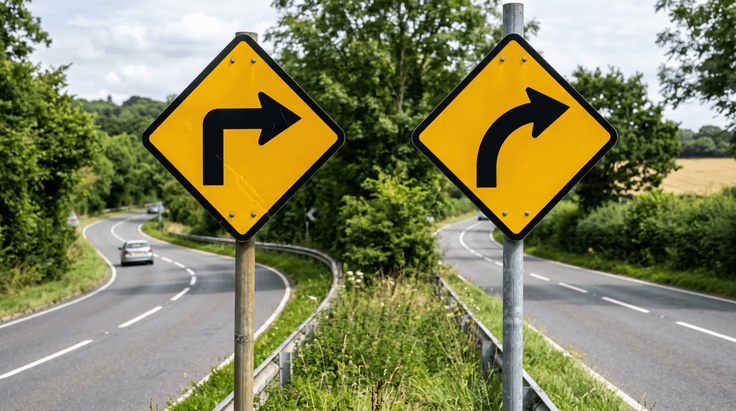
The Turn sign shows a sharp right-angle arrow. The Curve sign shows a gentle curving arrow. The difference looks small on paper. On the road, it's huge.
Turns need a bigger speed reduction than curves. DMV items test reading the arrow's sharpness. Usually one choice says ease off a bit and another one says slow way down, and they both sound okay if you're skimming. The right-angle arrow means a lot. Rushing through the question is how people pick the wrong one.
The way I explain it to students is pretty simple. A curve sign is the road politely leaning right, and you can usually take it with just a little off the gas. A turn sign is the road making a corner, close to what you'd do at an intersection, and you need to be going a lot slower to make it without crossing lines.
Where Is the Right Turn Sign Used?
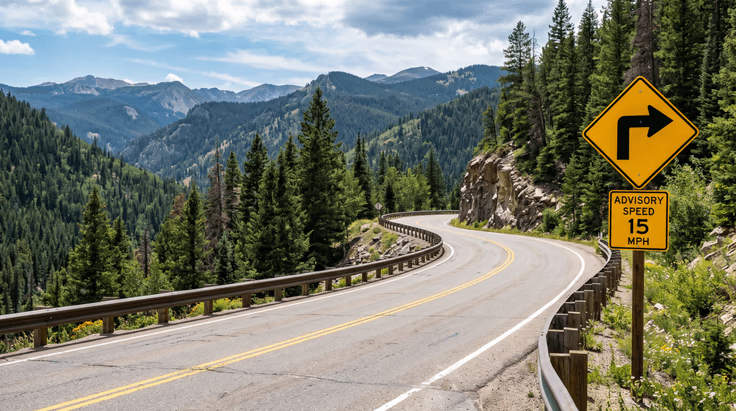
Mostly I see the turn ahead sign on country roads and mountain roads, right before a bend where the road just changes its mind about direction, and often it's a spot where you can't see around the corner till you're on it. Before turns too sharp for the normal road speed.
In mountainous parts of the state, these signs appear right after long straightaways. Drivers get comfortable. Then the road cuts right, and on the stretches with a steep drop on the side, that little yellow diamond might be the only heads-up you get before the guardrail.
Farm roads are another spot I see them a lot, where an old property line forces the road to jog around a field. Those turns often come with no shoulder, maybe a ditch, and gravel that's spilled onto the pavement from a driveway. The sign doesn't care why the road turns. All it does is tell you a turn's coming.
DMV Test Tips for the Right Turn Sign
Remember a sharp arrow means slow down more. Trick answers confuse a turn with a gentle curve. The written test at the DMV will show you both signs side by side sometimes. Only the arrow angle differs.
Right-angle arrow equals sharp turn, and the mistake I see most, on the test and in my car with students, is going into it too hot. If a question asks what the sign means, don't choose "road curves right." Choose "sharp right turn ahead." That word sharp is the entire point.
My little cue for it is "square corner, slow corner," and students seem to remember that one. Next time you do the signs part of a practice test, put your hand over the choices and say what the arrow's doing before you peek. Once you can call turn or curve at a glance, this question is free points. And if they ask when you should slow down, pick before the bend, never while you're in it.
Right Turn Sign FAQ
Is the Right Turn sign a regulatory sign?
No. It's a warning sign. It tells you what's ahead. Nobody can write you a ticket just for not doing something the sign suggests, since it doesn't order you to do anything by law.
Am I required to slow down to the advisory speed?
No. The advisory speed is recommended. Under right turn road sign rules, the advisory speed is not a legal limit. But go way over it and crash, and that can count against you as unsafe driving, so I wouldn't test it.
Turn sign or curve sign, how do I tell them apart?
The turn sign has a sharp right-angle arrow. The curve sign has a smooth, rounded arrow. Turn means slower.
Can the Right Turn sign appear with a speed plaque?
Yes. Many sharp turns have an advisory speed plaque mounted below the diamond. It's a small rectangle under the diamond with the mph number printed in black.
Does rain change anything?
Yep, go slower still. That posted advisory number is figured for dry pavement, so if it's raining or there's wet leaves or gravel on the road, go slower than what the plaque says.
Will this sign appear on the permit test?
Yes. It's a common warning sign question. Expect to see the turn arrow and the curve arrow next to each other and get asked to pick.
I'm already in the turn and going too fast. Now what?
Try not to stomp the brake, look at where you want the car to go, come off the gas a little and keep the wheel smooth. Hard braking mid-turn makes it worse.
The Right Turn sign isn't complicated. But the test writers know how to make it tricky. They'll show you a curve and call it a turn. Or a turn and call it a curve. The arrow angle is your answer. Sharp angle. Sharp turn. Slow down early, and you'll be fine on the test and on the road.
Share