Two-Way Traffic Sign: Meaning, Shape, and DMV Test Tips
What Does the Two-Way Traffic Sign Mean?
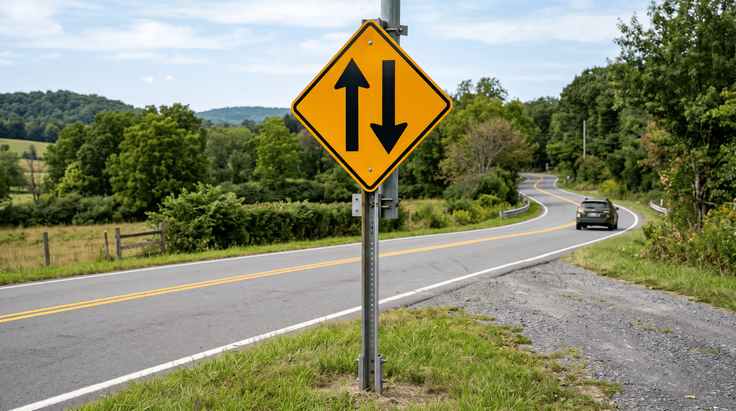
The two-way traffic sign meaning comes down to a heads-up from the road crew that the setup you've been driving on is about to change. It is posted just before oncoming vehicles can meet you head-on. A one-way street or divided highway is ending ahead. From that point on you're sharing the pavement with folks headed the other way, and there won't be a median or a whole separate road keeping them away from you.
I think of this as one of the more serious yellow signs out there, because for the last few miles your brain's been told nothing's coming at you. You get comfortable on a divided highway, you drift a bit toward the middle, and then a couple of minutes later the only thing between you and a pickup truck is a painted line.
What Does the Two-Way Traffic Sign Look Like?
You're looking for a yellow diamond with a black picture on it, same as a lot of the other warning signs you'll pass on a drive. It shows two vertical arrows. One arrow points up. The other points down. They sit side by side. No text. Just two arrows showing opposing flow. White's the color for signs that lay down the law, so seeing yellow here should tell you you're being warned, and I'd lock that in now.
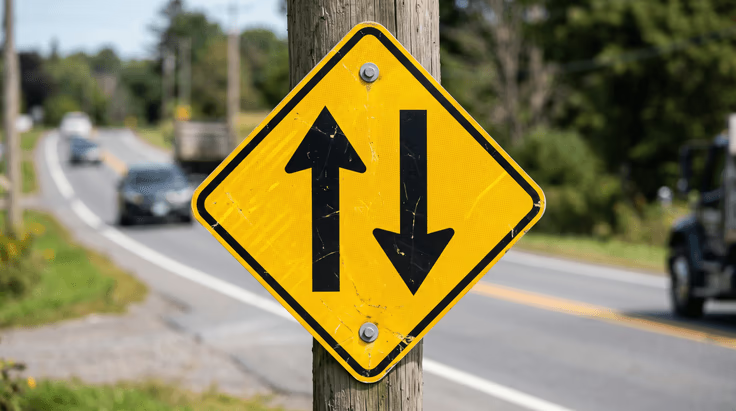
Ask a new driver what does two-way traffic sign mean and you'll usually get a shrug, and then I'll tell them to go by those arrows. The one-way or divided section ends ahead. Somebody's going to be coming the other way pretty soon, possibly in the very next lane over, so I'd get yourself to the right and stay off that center line. And if the permit test throws this at you, what it's really asking is whether you'd pass here (you wouldn't) and whether you're expecting cars to show up in front of you.
What Should You Do When You See Two-Way Traffic?
Get over and stay in the right lane, keeping half an eye on the centerline so you don't wander toward it. I wouldn't pass anybody at all unless there's a passing zone clearly marked up ahead, and even then only if you can see plenty of empty road. Look way down the road for headlights, especially at dusk or coming out of a curve. If it's a skinny road or one you've never driven before, ease off the gas a little, since nobody's ever failed a test or wrecked a car for going a touch slower there.
If you were about to pull out and go around a slow truck when this sign showed up, I'd forget it and wait. A lot of drivers have been doing it the whole way down the divided part and they don't stop to think that the rules of the road just changed on them. Getting stuck behind that truck for another few miles is really not a big deal.
Two-Way Traffic Sign vs. One Way Sign
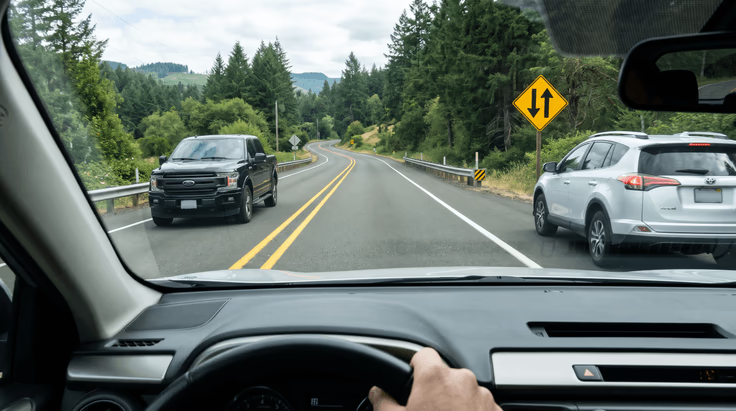
The two-way traffic road sign is often confused with the One Way sign. Here's the difference. The two-way traffic sign is a yellow diamond with two opposing arrows. The One Way sign is a rectangular black-and-white sign. The first is a warning. A One Way sign, though, is an actual rule, and you can get a ticket for ignoring it. The test may pair them to check your color and shape knowledge.
I'd go by shape and color before anything else on that one. If you've got a long black rectangle with white in it and an arrow pointing one direction, you can only go that way. When it's yellow and it's sitting on its point with two arrows going opposite ways, you're being told to look out for people coming at you. Neither one's hard once you've actually looked at them side by side for a minute.
Where Is the Two-Way Traffic Sign Posted?
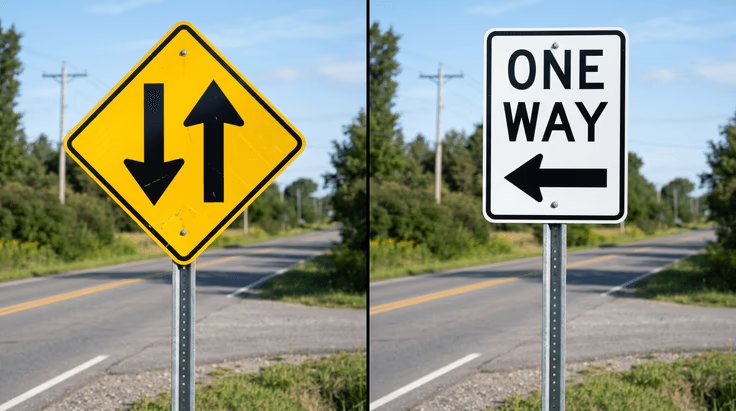
You'll mostly run into these at the spots where the road's about to change on you. At the end of a one-way street returning to two-way flow. Where a divided highway median ends. After a passing lane or climbing lane closes. You'll also spot one on a ramp coming off a highway when it drops you onto a surface street that's got cars going both directions, and around Houston or Phoenix I'd keep an eye out right before a frontage road feeds into a main road.
The climbing lane one's easy to miss, I think. You've had two lanes going uphill, you've got a nice rhythm, and then the extra lane goes away near the top with a car possibly coming over the crest from the other side.
DMV Test Tips for the Two-Way Traffic Sign
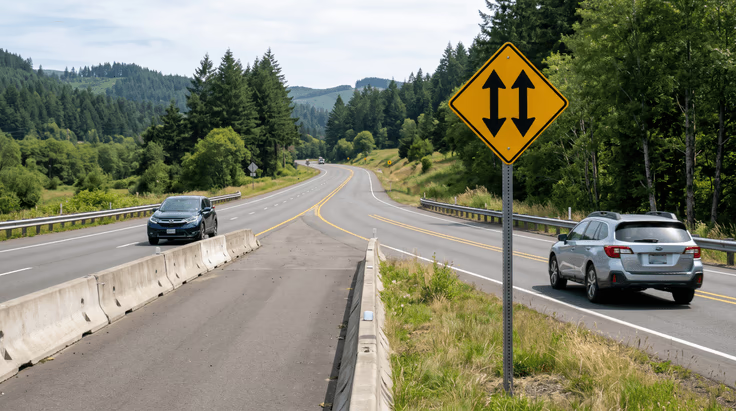
For the DMV test, remember this. Two arrows pointing opposite ways equal expect oncoming traffic. The correct action is do not pass and keep right. Don't mix it up with the divided-highway symbols, which show a road split by a median. The two-way traffic sign is a warning, so it's yellow. Not white. Not orange. Yellow.
A tiny real-life detail: two answers look right on the written test. One says "merge left," another says "do not pass." Choose the answer about oncoming traffic. The sign doesn't tell you to merge.
You'll probably see this one come up on the permit test and again in any part of the exam that's just about road signs, so I'd have my students get used to noticing the yellow diamond first and only then looking at what's drawn on it. Yellow diamond means warning. Two opposing arrows means traffic in both directions. Once you've got those two ideas tied together you won't need to study this sign again.
Two-Way Traffic Sign FAQ
Here are the ones my students ask me about most often when we're out driving.
Is the two-way traffic sign a warning or a regulation? It's a warning. It alerts you to oncoming traffic ahead.
Can you pass when you see this sign? Only if a passing zone is clearly marked. Don't pass if no passing zone is marked.
What's the difference between two-way traffic and divided highway signs? Divided highway signs show a median splitting the road. Two-way traffic shows opposing arrows side by side.
Does the two-way traffic sign have words on it? The standard symbol version has no text. Some states add a small plaque below.
Where do you usually see it? You'll see it:
- At the end of one-way streets.
- Where a divided highway ends.
- After a climbing lane closes.
So how come it keeps showing up on the permit test? I'd say it's because they want to know you can read a yellow diamond and that you won't try to pass somebody with a car headed straight for you, and honestly I'd want to know that too before I handed you a license.
On the permit test, you'll see this sign before a two-way road begins. Picture the road. A one-way street ends. A median disappears. A passing lane closes. Now there's a car coming at you. That's what the two-way traffic sign is telling you before you see it. Keep right. Don't pass. Expect headlights. You'll be fine.
Share