Divided Highway Ends Sign: Meaning, Shape, and DMV Test Tips
What Does the Divided Highway Ends Sign Mean?
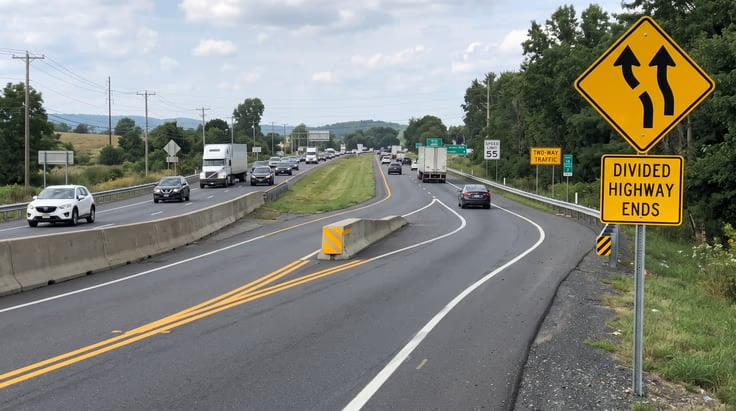
The divided highway ends sign meaning is a warning. What does divided highway ends sign mean? In plain words, that strip of grass or concrete curb you've had between you and the folks going the other way is about to run out, and pretty soon you're on a regular two-way road with nothing but paint between you and them. I see it most where a four-lane road slims back down near the edge of a town, right about where the gas stations thin out and the speed limit signs start getting bigger.
Up to now the median has been doing a lot of quiet work for you, giving a drifting driver room to recover before they ever reach your lane. Oncoming traffic now sits directly to your left. Once that median's gone, the only thing keeping a tired or distracted driver out of your lane is a yellow line and their own attention, so you want yours turned up a notch.
So you'll have cars coming at you on your left side, and that's really the whole point of the warning. Your passing opportunities shrink. The sign itself is an advance warning only. It doesn't change the speed limit. What it does change is how much room for error you've got, which is a lot less than you had a quarter mile back.
I tell students to treat it like a friendly heads-up from the road crew. Nobody's going to ticket you for the sign itself, but the drivers who get in trouble on these stretches are usually the ones who were still cruising like the median was there. Ease off a little, check your mirror, and settle into the right lane before the curb runs out instead of after.
What Does the Divided Highway Ends Sign Look Like?
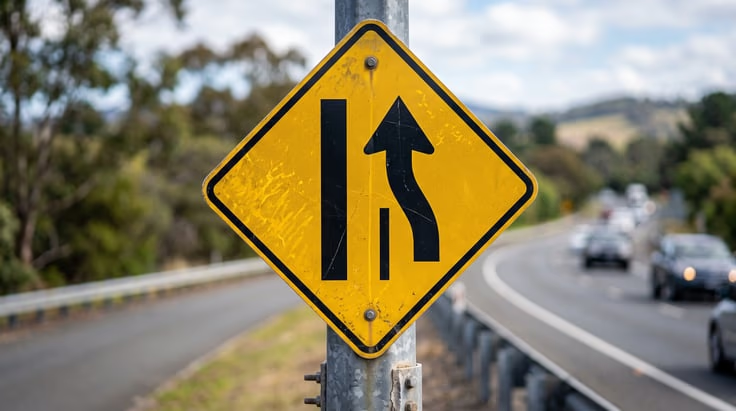
The shape and design are consistent with other warning signs. You're looking for the usual yellow diamond with black markings, same family as the curve and merge signs, and the picture on it has two lanes sitting apart near the bottom edge. They merge into one two-way road at the top. No words on the standard version. Just that converging image.
The way I picture it, the two lines are like a pair of chopsticks pinched together at the tip. Wide at the bottom where you are now, squeezed together up top where the road's headed. Because it's yellow, it belongs to the warning class, so it's telling you about something coming up rather than giving you an order like a red or white sign would. You won't find a speed number or any text on the normal version, so you really do have to read the drawing.
What Should You Do at a Divided Highway Ends Sign?
When you spot it, get over into the right lane before the median actually ends, not at the last second when the lanes squeeze down. Keep an eye out for headlights coming the other way (at night they show up a lot sooner than the cars do, which actually helps you). Forget about passing anyone while the road's narrowing, because that's just about the worst spot on the whole drive to be side by side with somebody. And I'd expect a two-way traffic sign to pop up shortly after, since the road crew usually likes to remind you twice.
That sequence is common.
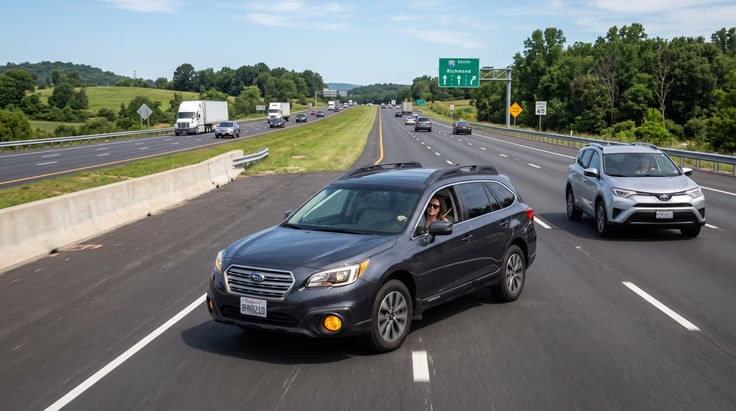
If you're behind a slow truck as the median ends, just hang back and wait for a proper passing zone with a broken yellow line. You'll lose maybe a minute. On a lot of rural roads the next legal passing stretch shows up within a few miles anyway, and the truck driver will often pull over to let a line of cars by once there's a wide shoulder.
Divided Highway Ends vs. Divided Highway Begins Sign
Here's where the DMV test gets tricky. The two signs show opposite lane movement. On the ends sign, lanes come together. Begins means they split apart. Both are yellow diamonds. The only real clue is which direction the lines converge.
This one trips people up.
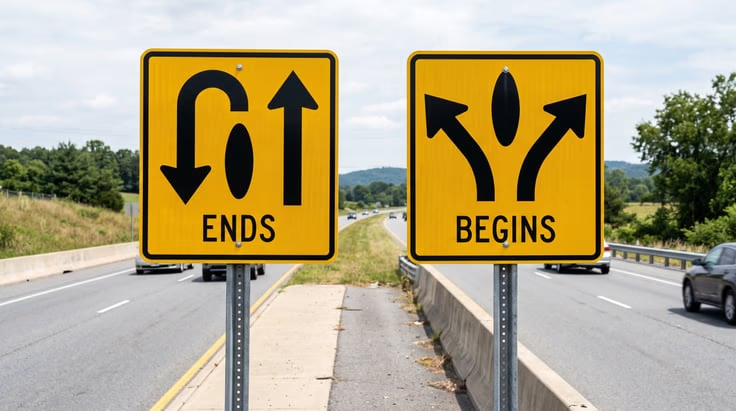
A quick way I remember it is to trace the lines with your finger from the bottom of the sign to the top, because the bottom is where you are and the top is where you're going. If your fingers get pushed together as they go up, the median's ending. If they spread apart, a median's starting and you're about to get your buffer back. The test question pretty much always hinges on that one detail, so spend two seconds on the drawing before you look at the answers.
Where Is the Divided Highway Ends Sign Used?
You'll see the divided highway ends road sign in specific places. Where a boulevard or expressway returns to a two-lane road. At the edge of town as a highway narrows. After a construction detour with a temporary median. On rural highways once a passing lane section finishes.
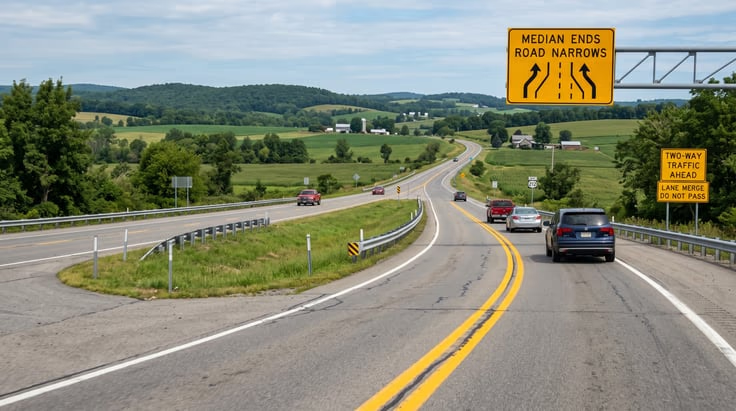
The construction version catches a lot of people off guard. Crews will sometimes set up concrete barriers to split traffic for a few miles, and when the work zone ends those barriers go away and you're back to facing oncoming cars. Out in the country it's the same story after a passing-lane stretch wraps up. Folks who were happily cruising in the left lane suddenly need to tuck back in, and the sign is there to give them time to do it calmly.
DMV Test Tips for the Divided Highway Ends Sign
For your permit test, lock this in: converging lines mean the median is ending. The key action they test is keep right and expect oncoming traffic. Just don't mix it up with the two-way traffic sign, which is the one with a pair of arrows aimed in opposite directions, one up and one down. And read answer choices carefully. Test writers love to put "begins" and "ends" side by side in the choices, and when you're skimming fast those two words blur together. Only one choice matches the line direction.
Remember the median disappears. The road becomes undivided. You lose your buffer.
When I quiz students on this one, I ask them what they'd physically do with the wheel, not just what the sign means. If your answer is "stay right and watch the oncoming lane," you've got it, and that's usually what the right answer choice says in slightly fancier words.
Divided Highway Ends Sign FAQ
Is the divided highway ends sign the same as a two-way traffic sign? No. The divided highway ends sign shows converging lanes. The two-way traffic sign is the one with arrows, one aimed up the road and one coming back down at you, and it tends to show up after this sign once the road's actually two-way.
Is the speed limit going down because of this sign? Not automatically. It warns about road layout, not speed.
What's the biggest mistake on the test? Choosing the divided highway begins sign because the graphics look similar.
So where do I put my car once I see it? Get into the right lane and stay put there until things settle down, which usually means once you've passed the end of the median and the first couple of oncoming cars have gone by.
Is this sign only on highways? No. It also appears on boulevards and expressways. You'll see it in temporary construction routes too.
What comes after this sign usually? Quite often you'll get a two-way traffic sign or a solid yellow no-passing line within the next stretch, so don't be surprised when one shows up.
How come the DMV keeps putting this sign on the test? Because a driver who reads it backwards might stay left or try to pass right where the road narrows, and that puts them nose to nose with oncoming traffic.
Share