Divided Highway Begins Sign: Meaning, Shape, and Test Tips
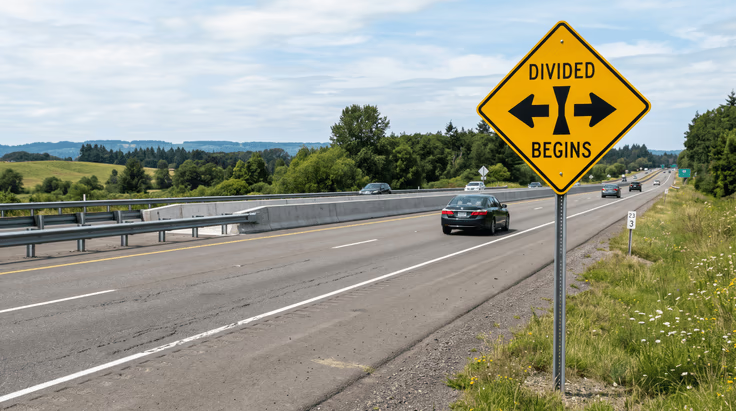
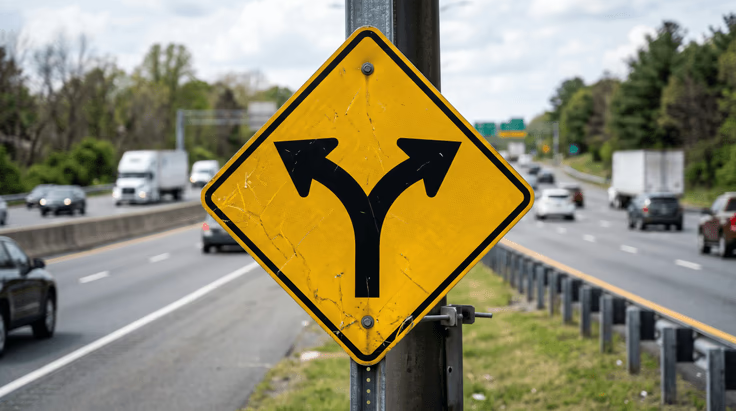
When you pass a divided highway begins sign, the road in front of you is about to turn into two one-way roadways with something in the middle keeping you and the oncoming cars apart, usually a median or a barrier. It's a yellow diamond, and on it there are two black arrows that pull away from each other with a median line starting up between them.
I like this sign because it gives you a heads-up before anything changes. You're still on a plain two-way road when you see it, and a bit farther along the oncoming lanes peel off to the other side of a divider. The permit test uses it to see if you can tell a divided highway starting from one ending, and I'll get to that mix-up below because it's where my students lose the point.
What Does the Divided Highway Begins Sign Mean?
Basically, up ahead the road turns into a divided highway, and the people coming the other way end up over on the other side of a barrier or a grass median. You stay right of that divider. Once the median starts, the oncoming cars are over on their own side of it, and you keep the median on your left.
Each direction gets its own roadway from that point on. That changes how you drive a little. You're not watching for a car drifting over the center line at you anymore, but you do need to be careful at the very start of the median, because that's the spot where people who aren't paying attention clip the curb or the nose of the barrier.
What the Divided Highway Begins Sign Looks Like
On the permit test you'll often just get the picture with no words, so it helps to know it on sight. It's yellow and shaped like a diamond (that's the warning sign shape), and the symbol on it is black. Two arrows point up. They separate near the top. A solid median line starts partway up and runs between them. Downward or merging arrows mean the divided highway ends sign. It's not the begins sign.
What to Do When a Divided Highway Begins
Keep right of the median. The median is starting, not ending.
Here's how I'd handle it out on the road. When you see the sign, ease off a little and check where the median actually starts, because at night or in rain the front edge of a curb can be hard to see. Stay in your lane on the right side of it. Don't try to make a left across the island where there's no opening, even if your turn is right there, since that puts you in the path of traffic that's now moving faster than it was on the two-way road. Go up to the next marked opening or intersection instead.
- Stay right of the median or island
- Don't turn across or drive onto the divider
- Expect one-way traffic in your roadway
- Expect higher speeds on the divided section
Each direction gets its own one-way roadway. The divider may be one of these:
- Raised concrete barrier
- Strip of grass
- Steel guardrail
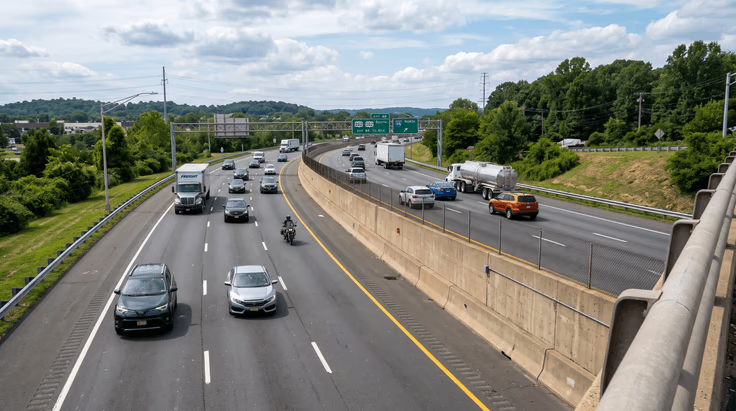
Divided Highway Begins Sign vs Divided Highway Ends Sign
Divided highway begins vs divided highway ends. This one trips people up.
The begins sign shows the median starting and traffic splitting apart. The ends sign shows the median stopping. After the ends sign you're back to two-way traffic on one road, with oncoming cars right next to you again. I've seen practice questions put the two signs right beside each other and ask which one is which, so look at the arrows before you answer. Pick the sign with the median starting and arrows splitting.
Out on the road, the ends sign matters just as much, because once the median stops you lose that buffer and the oncoming traffic is a few feet away. So if you just saw a divided highway warning sign a few miles back, keep an eye out for the ends sign later on the same road.
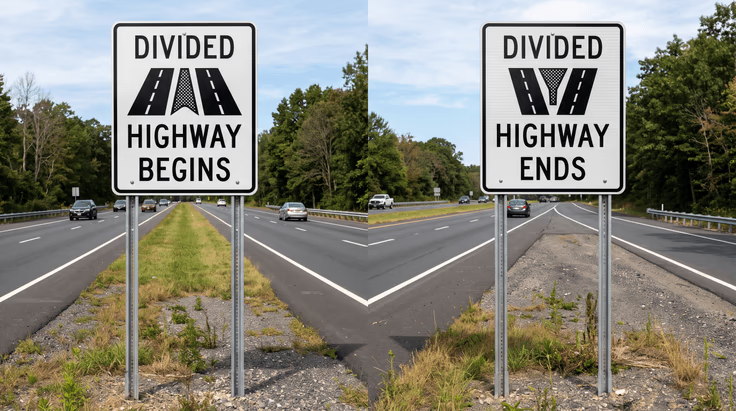
Where the Divided Highway Begins Sign Is Used
The sign appears on approaches to medians or center barriers. It also appears at entrances to expressways and parkways. Mostly you'll spot it right where a regular two-way road picks up a median, and in bigger cities you'll pass it heading onto an expressway.
Where is the divided highway begins sign used?
- Where a two-way road becomes a divided highway
- On approaches to medians or center barriers
- At entrances to expressways and parkways
- At transitions from undivided to divided roadway
This sign is not just for highways. I've seen it on plain town roads too, where a two-way street gets a grass island down the middle for a stretch.
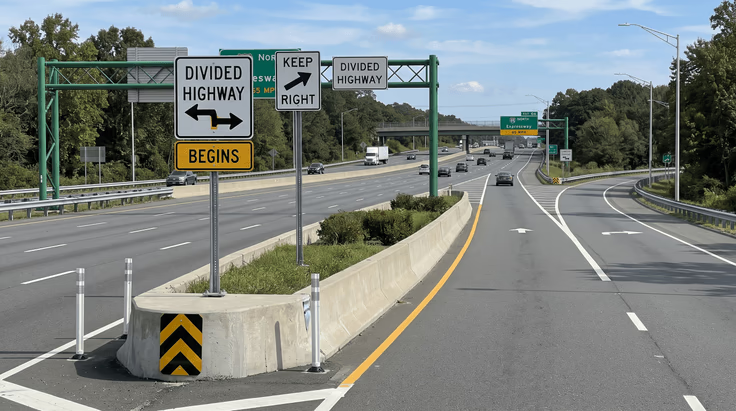
DMV Test Tips for the Divided Highway Begins Sign
On the test, look for two arrows split by a median that begins. That means keep right. A divider is starting. Opposing traffic moves to a separate roadway. The most common mistake is confusing begins with ends. Two answers look right, but only one shows the median starting.
What I tell students to do is say it out loud in their head. Arrows pulling apart with the median line starting between them is begins, and you keep right. Arrows coming back together with the median line stopping is ends, and you're about to have oncoming cars beside you again. If a question asks what you should do, the answer about staying right of the divider is nearly always the one they're after, and the answers about merging or getting ready for two-way traffic belong to the ends sign.
Divided Highway Begins Sign FAQ
FAQ about the divided highway begins sign
What does the divided highway begins sign mean? It means the road you're on is about to split into two one-way roadways with a median or a barrier between you and the oncoming traffic, so you stay to the right of whatever's in the middle.
What does divided highway begins mean for opposing traffic? Oncoming cars stay on the far side of the median. You will not share the same pavement with oncoming cars.
Is the divided highway begins sign the same as a divided highway ahead sign? Yes. A lot of people I teach call it the divided highway ahead sign. The official name is divided highway begins sign. Either way you're talking about the same yellow diamond.
What should you do when you see a divided highway warning sign? Keep the median on your left and don't drive over it or turn across it. Expect faster traffic on the divided section. From there on, your side is all one-way, and the oncoming cars have their own road over past the median.
How is the divided highway begins sign different from the ends sign? The begins sign shows arrows splitting apart with a median starting. The ends sign shows arrows merging together with a median stopping.
Can you turn across a median after the divided highway begins sign? No. Only cross at a marked opening in the median, and even then I'd follow whatever the signs at that opening tell you.
Does the DMV test ask about this sign? Yes. The DMV often uses it in warning sign questions. They may ask what the divided highway begins sign meaning is or show the image and ask what to do.
One tiny real-life detail: on a timed practice test, I once clicked "divided highway ends" because the arrows looked like they were coming together at the bottom. They were splitting at the top. That's the whole trick.
So when you see that yellow diamond, think split, median, keep right. The divided highway begins sign is not asking you to merge. It's telling you the road is about to separate.
Share