Right Curve Sign: Meaning, Shape, and DMV Test Tips
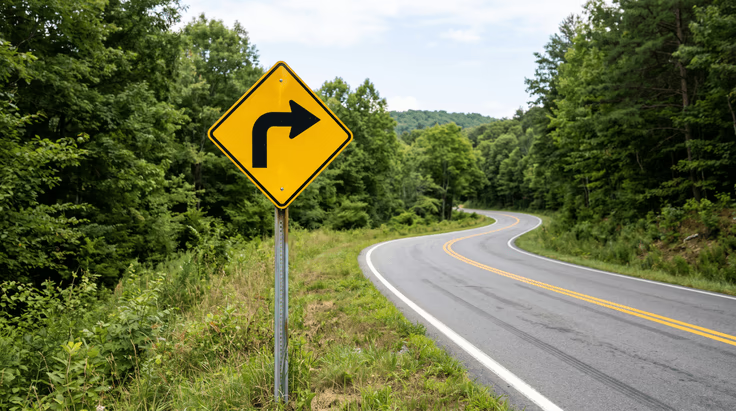
The right curve sign is a yellow diamond warning sign. It's telling you the road ahead is going to bend to the right, and not by much, which is exactly why the arrow on it is drawn as a soft sweep instead of a hard corner like you'd see on a sharp-turn sign. Permit tests use it to check speed adjustment. They also check that you can tell it apart from a sharp turn sign.
What Does the Right Curve Sign Mean?
The road up ahead bends right. Simple. It's a wide bend, so you won't need to crawl through it. You just need to be slower than you are on the straight. Ease off speed before you enter the curve. If there's an advisory plaque below the sign, that number is the comfortable speed for the curve, not a suggestion to ignore. Lots of my students lift off the gas way too late. By then they're already turning and braking at once, and that's the bad combo.
On lessons I ask "what's that sign say?" as soon as I see one. I want to hear "curve right, slowing down" while we're still on the straight. Say it, then do it. The written test is checking that same habit, honestly. It wants to see you slow down early when you see the warning.
What Does the Right Curve Sign Look Like?
It's a yellow diamond, standing on one point, usually on the right shoulder. Its black arrow curves smoothly to the right. The arrow is more rounded than the sharp-turn arrow. That rounded arrow is the whole story. The diamond shape marks it as a warning sign, same family as deer crossing or slippery road. Picture that same arrow bent into a hard right angle, like the corner of a book, and you'd be looking at the turn sign instead (I see students mix those two up on practice quizzes more than almost any other pair).
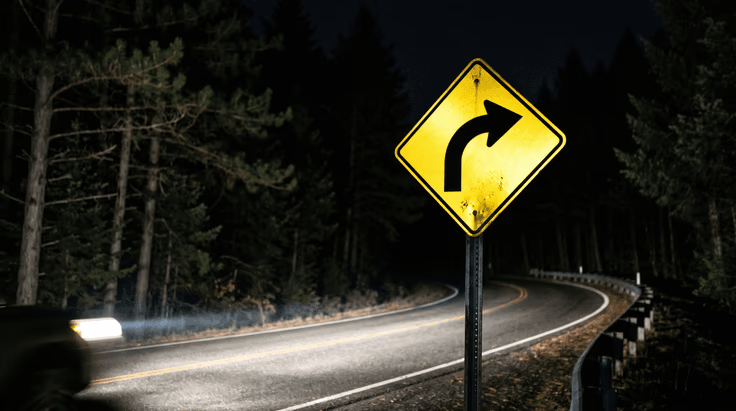
The arrow's tail can be a bit longer or shorter on different signs. Don't worry about that. Look at the bend. If it reads like a gentle hook, it's a curve. A square corner means it's a turn. The sign is reflective too. At night your headlights pick it up from pretty far back. Out on a dark country road, that's often your first heads-up about the bend.
What Should You Do When You See the Right Curve Sign?
When you see the right curve sign, reduce speed before entering the curve. Not during.
In the bend itself, keep the wheel steady. Small, even hand movements. Don't jab the brake halfway around. Braking hard while turned throws the car's weight forward and out, and the car can slide wide. Stay in your own lane all the way through. Look ahead to where the road goes, not at the hood. When it straightens out, get back on the gas slowly. New drivers love to floor it at the exit. I get it, the curve's over. But ease into it anyway.
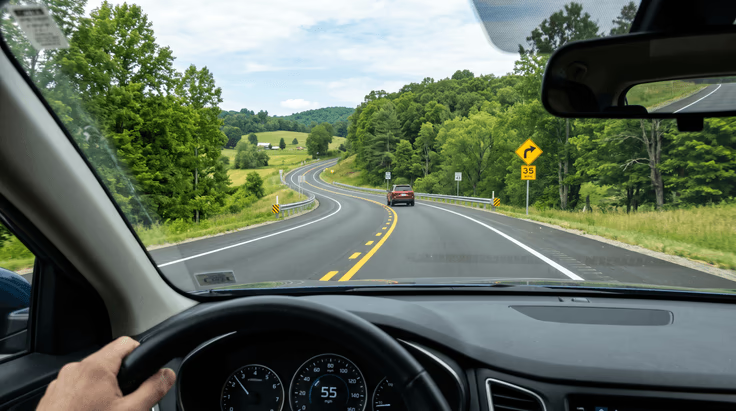
Practice this on a quiet road you drive a lot. Find a curve with a sign. Pick a spot to come off the gas before the bend. Do that curve five or six times. You'll notice you barely need to steer when your speed's right. And you'll feel calmer behind the wheel.
Right Curve Sign vs. the Sharp Right Turn Sign
Now, the right curve sign versus the sharp right turn sign. The curve sign shows a gentle, rounded arrow. The turn sign uses a sharp right-angle arrow. Sharp turns need a larger speed cut than curves. The DMV test items focus on the difference in arrow shape. Under time pressure, two answers look right. So look at the arrow first, then pick.
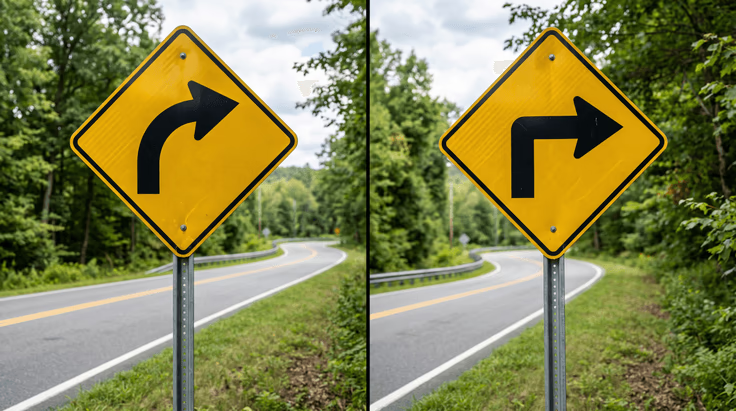
In the car, the big difference is how much you brake. For a curve, lifting off the gas is often enough. Maybe a light tap on the brake while you're still straight. A sharp turn usually needs real braking, and earlier. Mix them up one way and you come in too fast. Mix them up the other way and the guy behind you gets annoyed.
Where Is the Right Curve Sign Used?
Most of the ones I point out to students are out on highways and country roads, posted a little before a long, gradual bend where the road follows a hillside or a river. It's placed where a curve could surprise a fast driver, especially at sweeping bends with limited sight lines. Often there's an advisory speed plaque below it. You may not see it on wide city boulevards. You will see it more outside urban areas.
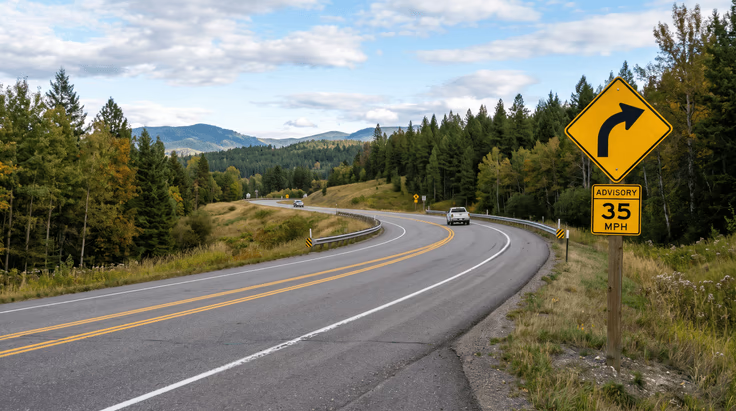
Hills and trees block your view of where the road goes. So do fences, and corn fields in August. A bend can look easy from far off and get tighter once you're in it. This sign is for exactly that spot. See a speed plaque with it? Be at that speed when the curve starts. Don't start braking from it.
DMV Test Tips for the Right Curve Sign
On the test, a rounded arrow means a gentle curve. Trick answers swap it with the sharp-turn sign. A smooth arrow is the curve. A hard corner is the turn. Another wrong answer shows up a lot too. It's the driver who keeps the same speed into the bend. Skip that one. You might get a question about what to do. Follow right curve road sign rules:
- Slow early.
- Keep the wheel steady.
- Hold your position inside your own lane.
The right answer has you slowing before the curve. If an answer has you braking hard in the middle of it, cross it off.
Watch the wording too. Some questions don't show a picture. They describe the sign in words. "Gentle," "rounded" or "curved" means the curve sign. "Sharp" or "right angle" means the turn sign.
Right Curve Sign FAQ
A curve ahead sign is broader than a right curve sign. The right curve sign specifies direction. The right curve warning sign meaning is the same in every state. Where it gets posted can differ a bit. Here are the curve to the right sign rules again:
- Slow early.
- Keep your hands steady.
- Don't drift out of your lane.
What does the right curve sign mean?
The road bends gently to the right. Slow down a bit before you get there.
How is it different from the sharp right turn sign?
Check the arrow. Curve signs have a rounded arrow and turn signs have a square corner. For a sharp turn you slow down more.
So when do I actually slow down?
While you're still on the straight part. Don't wait and brake hard in the middle of the bend.
What does the number on the plaque below the sign mean?
That's an advisory speed, the comfortable speed for getting through the curve. Be at or below it when the bend begins.
Where do these signs usually show up?
Highways and rural roads, before long bends. You'll see more of them where hills or trees block the view.
What do people get wrong most?
They go into the curve at full speed. Then they brake or speed up hard halfway through.
On a two-lane road, keep an eye on oncoming cars in a right-hand bend. They tend to drift toward the center line. Some cross it. Stay toward the right side of your lane so you've got room. It's about where your wheels are when someone else cuts the corner.
Final tip for the permit test. Don't overthink a yellow diamond with a curved arrow. It's a right curve sign. Slow before the bend. Keep your line. Move to the next question.
Share